This comparison is for educational purpose. Bio-Synthesis offer 3rd generation bridged nucleic acid BNA. BNA can be use to replace LNA and PNA. For LNA or PNA oligo contact Exiqon or Panagene.
Introduction
Detection of nucleic acid sequences is widely used in many biological assays, with increasing penetration into clinical sciences and other areas of life sciences. Quite often fluorescent tagged DNA sequences, either from naturally occurring sequences or synthetic oligonucleotides, are used to probe a sample of interest. Synthetic non-natural analogs have also been found useful in increasing specificity of detection. Here we take a look at two synthetic analogs: Locked Nucleic Acids (LNAs) and Peptide Nucleic Acids (PNAs).
Thermodynamic comparison of LNA and PNA probes
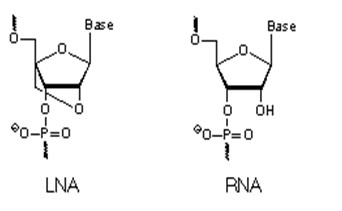
Figure 1. Structure of LNA
LNAs are a class of conformationally restricted nucleotide analogs, in which the ribose ring is constrained by a methylene linkage between the 2’oxygen and the 4’ carbon resulting in the locked 3’endo formation (Figure1).
The incorporation of LNA in an oligonucleotide increases the affinity of that oligonucleotide for its complementary RNA or DNA target by increasing the melting temperature (Tm) of the duplex. Additionally, the Tm difference between a perfectly matched target and a mismatched target is substantially higher than that observed when a DNA-based oligonucleotide is used. The properties like —high Tm and excellent mismatch discrimination—make LNA-modified probes ideal for analysis of short and very similar targets like miRNAs. Furthermore, by adjusting the LNA content and probe length, it is possible to design Tm-normalized probes, thereby allowing hybridization conditions that are optimal for all probes used on, for example, an array.
LNAs were seen to display increased thermodynamic stability and enhanced nucleic acid recognition. Initial investigations of LNA melting temperatures (Tm) by Koshkin et al. (1998) revealed increased values per LNA monomer(Tm) of +3 to +5oC and +4 to +8oC against complementary DNA and RNA oligonucleotides respectively.
Structural studies have shown that LNA oligonucleotides force an A-type (RNA-like) duplex conformation. Their melting temperatures increased by 1 to 8°C against DNA and 2 to 10°C against RNA by one LNA substitution in an oligonucleotide. An increase in the number of LNA bases within an oligo, such as a qPCR probe, increases Tm value significantly as can be seen below :
|
Probe Sequence (5'->3')
|
LNA base
|
Tm*
|
Tm
|
Tm/LNA
|
|
dG dT dG dA dT dA dT dG dC
|
-
|
29ºC
|
-
|
-
|
|
dG + T dG dA + T dA +T dG dC
|
3
|
44ºC
|
15ºC
|
+5ºC
|
|
+ G + T + G + A + T + A + T + G + C
|
9
|
64ºC
|
35ºC
|
+3.9ºC
|
Tm of duplex between probe and its complementary DNA sequence Note: + symbol denotes the LNA base.
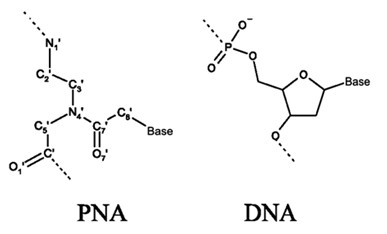 Figure 2. Structure of PNA
Peptide nucleic acids (PNAs) are oligonucleotide analogues in which the sugar-phosphate backbone has been replaced by a pseudopeptide skeleton. PNAs bind DNA and RNA with high specificity and selectivity, leading to PNA–RNA and PNA–DNA hybrids more stable than the corresponding nucleic acid complexes.
The thermal stability of PNA:DNA and PNA:RNA is higher compared to DNA:DNA and DNA:RNA duplexes. The stronger binding is attributed to the lack of charge repulsion between the neutral PNA and the negatively charged DNA or RNA strand. Also, the PNAs are insensitive to variations in salt concentration and PNA:DNA exhibit minor dependence from 10-50mM sodium chloride. This is in contrast to DNA:DNA duplexes, which are highly dependent on ion concentration. At low concentration PNA can bind to a target sequence at temperatures where DNA:DNA hybridization is suboptimal.
Ability of PNA probes to invade double stranded DNA
PNA probes can bind to either single stranded DNA or RNA or to double stranded DNA homopyrimidine PNAs with a minimum of 10-mers, as well as PNAs containing a high proportion of pyrimidine residues, bind to complementary DNA sequences to form highly stable (PNA)2–DNA triplex helices displaying Tm over 70°C. In these triplexes, one PNA strand hybridizes to DNA through standard Watson–Crick base pairing rules, while the other PNA strand binds to DNA through Hoogsteen hydrogen bonds. The resulting structure is called P-loops. The stability of these triple helixes is so high that homopyrimidine PNA targeted to purine tracts of dsDNA invades the duplex by displacing one of the DNA strands. The efficiency of this strand invasion can be further enhanced by using two homopyrimidine PNA oligomers connected via a flexible linker or by the presence of nonstandard nucleobases in the PNA molecule.
Stable triplex invasion complex, leading to the displacement of the second DNA strand into a D-loop.
Significant applications of LNA probes
| |
- Application of LNA probes in miRNA analysis
miRNA analysis imposes many challenges, for example LNA modified capture probes may result in a more sensitive detection of miRNA in comparison to unmodified DNA-based capture probes. Furthermore, some miRNAs differ from each other by as little as a single nucleotide, emphasizing the importance of good mismatch discrimination. LNAs have proven to be extremely useful in overcoming these obstacles, particularly in the areas of miRNA profiling and in situ hybridization.
|
| |
- LNA fluorescent probes for Real Time (quantitative) PCR
Development of LNA fluorescent probes are an alternative in real time PCR and analytical assays including gene expression profiling, mutation detection, allelic discrimination and pathogen detection
|
| |
LNA oligonucleotides and siLNA duplexes can be transfected into cells using standard reagents and have been shown to predictably mediate gene silencing as single stranded antisense agents. Animal studies have confirmed the potency of single stranded antisense LNA oligonucleotides and siLNA duplexes for gene silencing applications. Single stranded LNA antisense molecules are in clinical trials as anticancer agents.
|
Applications of peptide nucleic acid probes
| |
- PNA fluorescent In situ hybridization
The PNA-FISH technique was first developed for quantitative telomere analysis. Using a unique fluorescein-labelled PNA probe, thus one can map the 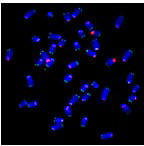 sequence onto a chromosome. sequence onto a chromosome.
In FISH applications, PNA probes have several remarkable properties. One of the most powerful aspects of PNA-probe based explorations of chromosome structure is due to the exquisite base-discrimination in FISH applications. Very short PNA oligomers can be effectively utilized. Despite the short length of the PNA oligomers the strength of interaction with target, and hence the strength of the FISH signal, is greater than for a DNA oligomer. As a result, PNA oligomer probes are capable of very specific and discriminate interactions with nucleic acid targets. Research has shown that PNA probes are capable of single base discrimination in FISH experiments. Because of the exquisite sequence discrimination of PNA probes in FISH applications, PNA-FISH has great potential in the growing area of Single Molecule Genomics.
PNA may be used in many of the applications where PNA become a versatile tool in genetic diagnostics and a variety of molecular biology techniques such as PCR clamping, plasmid vector tagging and nucleic acid solution phase hybridization detection.
|
| |
- Antisense and antigene applications
The unique properties of PNA as a DNA mimic have been attributed for gene therapy and drug design since, PNAs can inhibit transcription and translation of genes by tight binding to DNA or mRNA. For example, PNA mediated transcription inhibition was demonstrated for the alpha-chain of the interleukin-2 receptor, even an 8-mer PNA can efficiently block transcriptional elongation by (PNA)2–DNA triplex formation.2
The mechanism of antisense activity has been attributed by RNase-H mediated degradation of the mRNA-oligonucleotide hybrid. Since PNAs are not substrates for RNase, their antisense effect acts through steric interference of either RNA processing, transport into cytoplasm or translation, caused by binding to the mRNA.
|
| |
- PNA as a major Delivery agent
PNAs can be used as adapters to link peptides, drugs or molecular tracers to plasmid vectors. According to the binding site, the coupling of PNAs to plasmids has no effect either on the transcription of genes included in the plasmid or on the plasmid's physiological activities. Thus, this approach allows circumvention of such barriers to gene transfer and fixation of drugs to plasmids in order to enhance the gene delivery or tissue-specific targeting.
Using a triplex forming PNA as a linker there is an eight times higher nuclear localization of a coupled nuclear localization signal (NLS) than with the free oligonucleotide.
|
|
General applications of LNA and PNA probes
|
|
Locked Nucleic Acid (LNA)
|
|
Peptide Nucleic Acid (PNA)
|
|
|
|
- The efficiency of PNAs as hybridization probes has also been demonstrated in fluorescence in situ hybridization (FISH) applications
|
|
|
|
- PNA probes are used for the detection of single-nucleotide polymorphisms
|
|
|
|
- LightUp and LightSpeed probes are unique reagents for real-time PCR, which combine fluorescent enhancement with the high sensitivity and specificity of PNAs
|
|
|
|
- PNAs constitute as efficient compounds for effective antisense/antigene application where PNA inhibits expression differently than antisense oligonucleotides acting through RNase-H mediated degradation of the mRNA–oligonucleotide hybrid
|
|
|
Pros and cons of LNA over PNA
|
|
|
|
- Unmodified PNA cannot serve as a primer for polymerization, nor can it be a substrate for exonuclease activities of Taq polymerase.
|
|
|
|
- Whereas PNA has a low aqueous solubility
|
|
|
|
- PNA on the other hand resembles closely on the peptide chemistry. Therefore PNA-DNA chimeras are not readily synthesized
|
|
Conclusion
PNA and LNA probes contribute in many areas of applications like antigene and antisense therapeutics, SNP genotyping assays, Fluorescent insitu hybridization etc. Apart from the applications there are certain drawbacks where LNA probes are preferred over PNA probes- firstly, PNA resembles closely on the peptide chemistry and therefore PNA-DNA chimeras are not readily synthesized, whereas LNAs are synthesized using conventional phosphoramidite chemistry.
LNA substitution couples the high affinity binding that characterizes recognition by PNAs with retention of phosphodiester backbone of DNA or RNA. Therefore it is supposed that LNA’s would be ideal candidates for examining whether efficient inhibition of gene expression could be extended beyond PNAs to negatively charged, synthetic oligonucleotides.
References
- Bondensgaard, K., M. Petersen, S. K. Singh, V. K. Rajwanshi, R. Kumar, J. Wengel, and J. P. Jacobsen. 2000. Structural studies of LNA:RNA duplexes by NMR: conformations and implications for RNase H activity. Chemistry 6:2687-2695.
- Egholm, M., O. Buchardt, L. Christensen, C. Behrens, S. M. Freier, D. A. Driver, R. H. Berg, S. K. Kim, B. Norden, and P. E. Nielsen. 1993.
- Perry-O'Keefe, H., S. Rigby, K. Oliveira, D. Sørensen, H. Stender, J. Coull, and J. J. Hyldig-Nielsen. 2001. Identification of indicator microorganisms using a standardized PNA FISH method. J. Microbiol. Methods 47:281-292
- McTigue, P.M.; Peterson, R.J.; Kahn, J.D. Sequence-dependent thermodynamic parameters; for locked nucleic acid (LNA)–DNA duplex formation. Biochemistry. 2004;43:5388–5405. [PubMed]
- Castoldi, M. et al. A sensitive array for micro RNA expression profiling (miChip) based on locked nucleic acids (LNA). RNA
- Fiandaca, M.J.; Hyldig-Nielsen, J.J.; Gildea, B.D.; Coull,J.M. Self-reporting PNA/DNA primers for PCR analysis.Genome Res. 2001, 11, 609–613
|
|